
Mughals Visit Dargah Ajmer – Imperial Faith, Mosques & Endowments
Khwaja Buzurg and the Beliefs of the Mughal Empire
Emperor Akbar the Great (Shahenshah-e-Akbar-e-Azam)
Sultan Jalaluddin Muhammad Akbar paid his respects at Ajmer Sharif multiple times. In the sixth year of his ascension to the throne, while returning from Akbarabad (Agra) to Fatehpur for a hunting expedition, he met some villagers near a village singing a Hindi song in praise of Khwaja Buzurg. Akbar already held a deep, unseen devotion and proximity toward Hazrat Khwaja Sahib. Hearing the song moved him immensely, creating an ardent desire in his heart to present himself at the holy tomb of Khwaja Sahib and rub his forehead at the threshold.
- Khwaja Buzurg and the Beliefs of the Mughal Empire
- Emperor Akbar the Great (Shahenshah-e-Akbar-e-Azam)
- Emperor Jahangir
- Emperor Shah Jahan
- Devotion of Princess Jahanara
- Visit of Prince Dara Shikoh
- Dara Shikoh writes in his book Safinat-ul-Auliya:
- Sultan Aurangzeb Alamgir
- Tribute of Devotion from Bahadur Shah Zafar
- (Source: Book 'Bahadur Shah Zafar and His Era')
In 966 AH, Emperor Akbar the Great visited the court of Sultan-e-Sanjar for the very first time. He spent vast sums in offerings and devotion (Nazar-o-Niyaz) with such generosity that not only the shrine caretakers (Khuddam-e-Aastana) but the entire populace of the city became prosperous.
In 972 AH, Akbar the Great visited the grand court at Ajmer for the second time, on foot, following his victory at the Fort of Chittorgarh. He enriched the shrine attendants (Mujaweer) and other residing dervishes with royal gifts and honors. He presented the Large Cauldron (Deeg-e-Kalan) as an offering and had a pavilion (Chattri) constructed adjacent to it, inside which a brass lampstand (Chiragdan) was installed.
Through the prayers and blessings of Khwaja Buzurg, Prince Salim (Nur-ud-din Muhammad Jahangir) was born to Akbar on 17 Rabi al-Awwal 977 AH. After celebrating the prince's birth, Akbar traveled on foot during mid-Sha'ban, covering 12 Kohs (a traditional unit of distance) daily, to attain the privilege of kissing the threshold of the shrine. He offered substantial sums in devotion and ordered the construction of a building for the comfort of pilgrims near the Akbari Mosque, which is known today as the Khanqah.
Emperor Akbar's Barefoot Pilgrimage
In 1570 CE, after the birth of Prince Salim (Jahangir), Emperor Akbar walked barefoot the entire distance of over 350 kilometers from Agra to Ajmer Sharif in thanksgiving to Khwaja Gharib Nawaz.
In 978 AH, Akbar visited the shrine of Khwaja Sahib to offer prayers of thanksgiving for the blessed birth of Prince Murad. On this occasion, he ordered the construction of a solid protective outer wall (Faseel) around Ajmer Sharif and a royal residence (Magazine).
In 980 AH, during the last days of Safar, he again paid his respects at the court of Khwaja Sahib.
In 981 AH, Prince Daniyal was born in the residence of Sheikh Daniyal, an esteemed member among the noble caretakers.
In 982 AH, to express gratitude for the conquest of Bengal, Akbar visited during the blessed month of Ramadan to kiss the threshold. As per custom, he offered generous devotions and presented a large pair of kettle drums (Nakkara) to the drum-house (Nakkar-Khana) of the shrine, which exists to this day. On this occasion, he commanded that a palace be built at every stage of the route from Akbarabad to Ajmer, along with a minaret (Minara) and a well at every Koh.
Emperor Jahangir
Sultan Nur-ud-din Muhammad Jahangir arrived in Ajmer on 5 Shawwal 1022 AH. When the blessed dome of the holy shrine became visible from a distance of one Koh, he dismounted his carriage, traveled on foot, and kissed the threshold. He bestowed gifts and alms upon the poor and needy, presented offerings to the shrine caretakers, and offered the Small Cauldron (Deeg-e-Khurd), which is situated near the Buland Darwaza.
In 1023 AH, during mid-Jumada al-Thani, Jahangir fell gravely ill. When various medical treatments brought no relief, he turned to the court of Sarkar Gharib Nawaz to pray for health and recovery, vowing to present generous offerings and charity. Through the prayers and grace of Sarkar Gharib Nawaz, Jahangir recovered shortly thereafter. He immediately visited the shrine of Khwaja Sahib, wore the ring of servitude (Gulami ka Halka) in his ears, presented rich offerings to the shrine caretakers, enriched their status, and filled the bags of the poor and needy.
On this occasion, the site of Chashma-e-Hafiza Jamal—the noble daughter of Sarkar Gharib Nawaz—was highlighted. Her place of spiritual retreat (Chilla) was located on a hill connected to a spring at the foot of Taragarh Fort.
The spring was named Chashma-e-Hafiza Jamal. (Bibi Hafiza Jamal is buried near the feet of our Khwaja inside the holy dome). Jahangir ordered the construction of imperial royal quarters at this location and named the place Noor Chashma. Court poet Saad Gilani composed a chronogram for the date, which was inscribed upon the archway.
On 5 Rajab 1024 AH, during the 6th night of the annual Urs Mubarak of Sarkar Gharib Nawaz, Jahangir had the honor of participating in the special spiritual audition gathering (Sama).
Upon his departure, he personally distributed six thousand rupees in cash to the noble caretakers and eminent Sufis. He also distributed seventy rosaries made of pearls, corals, and amber. During his stay in Ajmer, he spent 1,10,000 rupees to construct a golden railing (Sunehri Kathera) around the sacred tomb of Sarkar Gharib Nawaz. Emperor Jahangir stayed in Ajmer Moalla for nearly three years on this occasion.
Princess Hur-un-Nissa, daughter of Shah Jahan, had also accompanied Emperor Jahangir to Ajmer and resided alongside the royal ladies. It is recorded in Tuzk-e-Jahangiri that on Wednesday, 29 Jumada al-Awwal 1025 AH, Hur-un-Nissa passed away suddenly. She was buried under the shadow of the western wall of Khwaja Sahib's holy dome. Jahangir was deeply grieved by the passing of his granddaughter.
Emperor Shah Jahan
Shahabuddin Muhammad Shah Jahan visited Ajmer Moalla multiple times during his princehood. During his 21-year reign as Emperor, Shah Jahan visited the holy shrine of Sarkar Gharib Nawaz five times to perform pilgrimage and gather spiritual blessings.
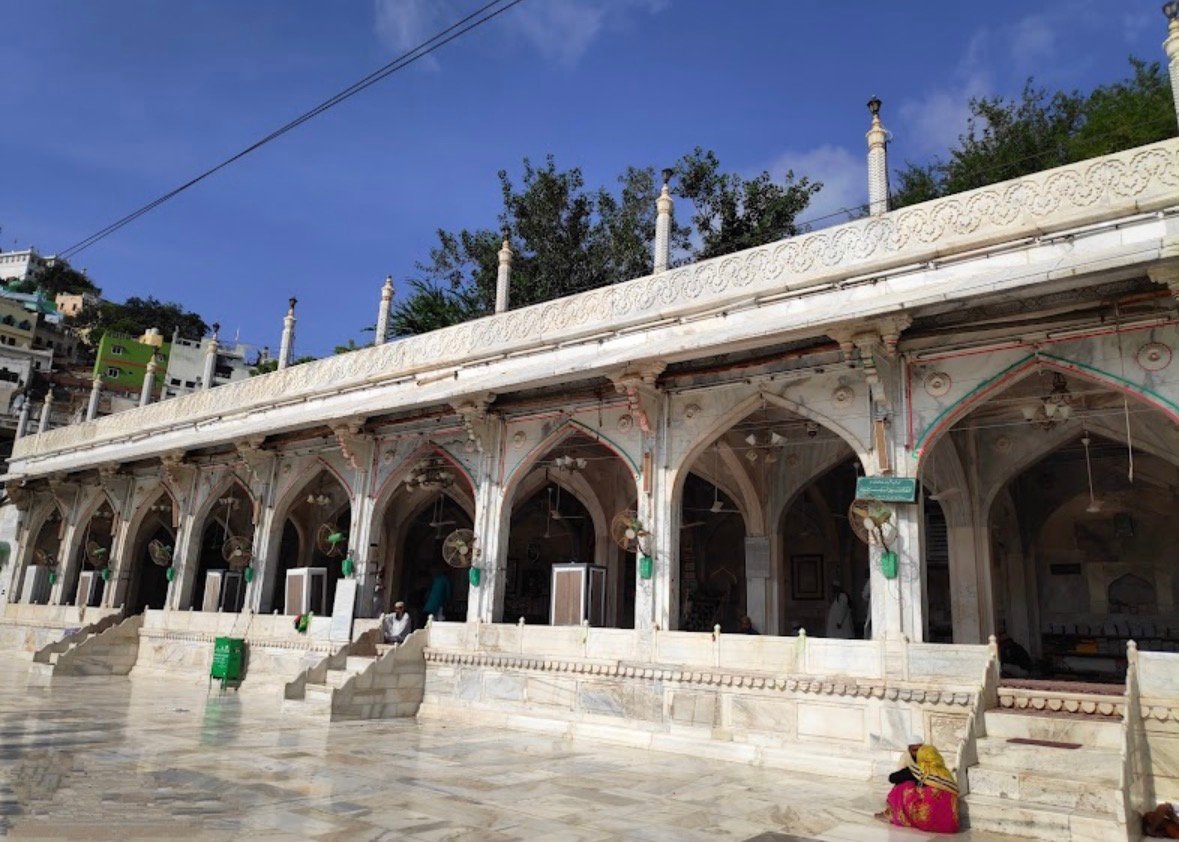
On 20 Muharram 1024 AH, after securing victory over the Rana of Udaipur, Prince Shah Jahan reached Ajmer to serve Emperor Jahangir. While paying respects at the court of Sarkar Gharib Nawaz, the idea arose in his heart to construct a mosque in the grand court. Consequently, upon ascending the throne, he ordered the construction of a mosque at the shrine of Khwaja Sahib, known today as the Shah Jahani Mosque. The construction of this mosque was completed in 1047 AH.
In addition to this mosque, Emperor Shah Jahan constructed a beautiful marble pavilion along the banks of Ana Sagar Lake in Ajmer as an imperial residence, which remains unmatched in its elegance. Emperor Shah Jahan usually stayed in this royal pavilion during his visits.
Mulla Abdul Hamid Lahori, a historian of the Shah Jahani era, writes regarding Shah Jahan’s visit in 1025 AH:
The Emperor presented offerings to the caretakers and attendants of the noble shrine, distributed alms to the poor of Ajmer city, and granted stipends in their names, fulfilling their needs."
Emperor Shah Jahan not only granted financial support (Madaad-e-Maash) to the shrine caretakers, but he also reformed the temporary land grants (Jaageerat) that had been provided since Akbar's era for overall shrine expenses, officially dedicating 17 villages as an endowment (Waqf) for the shrine. Shah Jahan had no intention of creating a private estate or lordship; rather, he estimated the shrine's maintenance costs based on its income and dedicated the revenues of these villages strictly for shrine expenses and charitable activities.
Devotion of Princess Jahanara
Like the male rulers of the Mughal Dynasty, royal women were also deeply devoted to Khwaja Buzurg. Among them, Emperor Shah Jahan’s eldest daughter, Princess Jahanara, held the deepest devotion. The Princess writes in her memoir that on 18 Sha'ban 1053 AH, she set out for Ajmer with her revered father. During the journey, at every stage, she recited two units of voluntary prayer (Nafal), Surah Yaseen, and Surah Fatiha with deep faith. She wrote: "By the grace of the Lord of the worlds, I am approaching that court where even angels take pride in visiting." Upon reaching Ajmer, she stayed at the Baradari of Ana Sagar Lake and, out of utmost reverence, never slept on a cot/bed during her stay. The Begami Dalan at the holy shrine of Huzoor Gharib Nawaz stands today as a lasting monument to Princess Jahanara’s devotion.
Visit of Prince Dara Shikoh
Dara Shikoh writes in his book Safinat-ul-Auliya:
This humble servant has had the privilege of visiting the luminous shrine of Khwaja Gharib Nawaz multiple times. This dervish was born in the region of Ajmer above the Ana Sagar Lake. My father (Emperor Shah Jahan) had three daughters, but no son had been born, and my father was 24 years old. Out of sincere devotion, Emperor Shah Jahan presented offerings and supplications to Khwaja Gharib Nawaz. By the grace of his prayers, God granted birth to this dervish." (Safinat-ul-Auliya, Page 129)
Sultan Aurangzeb Alamgir
Emperor Aurangzeb visited the shrine for the first time in 1068 AH. Out of respect for the sanctuary of Hazrat Khwaja Sahib, he observed the ornate decorations at the tomb of Nizam Saqqa and remarked: "How can the light of a candle be displayed in front of the sun?" He commanded that the decorative items be removed from Nizam Saqqa's tomb. Thereafter, he paid his respects at the main shrine, circumambulated the luminous tomb, and presented five thousand rupees as an offering to the shrine caretakers.
In 1090 AH, he was blessed to visit a second time. From the quarters of Jahangir, he again presented five thousand rupees as an offering to the shrine caretakers. He paid his final visit to the holy threshold in 1091 AH.
Tribute of Devotion from Bahadur Shah Zafar
On 10 July 1840, for the annual devotions (Niyaz) commemorating Shahenshah-e-Auliya Khwaja Moinuddin Chishti, Emperor Bahadur Shah Zafar presented a silver lamp (Chirag), a pair of kettle drums (Nakkara), a gold coin (Ashrafi), and five rupees to the poor who carried the ritual henna (Mehendi). These devotees traveled barefoot from Delhi to Ajmer Sharif carrying the henna every year.
On 25 July 1845, Bahadur Shah Zafar visited the shrine of Qutb-ul-Aqtab (Hazrat Qutbuddin Bakhtiyar Kaki). The henna procession bound for Huzoor Gharib Nawaz in Ajmer was prepared for departure. The Emperor granted one hundred rupees to Mirza Bahadur Baksh to lead the procession, ordered two four-horse carriages, two camels, and carpet attendants to accompany the party, and personally walked along in escort up to the Auliya Mosque before taking leave. ("Mehendi" refers to the procession that travels on foot to the Urs of Ajmer Sharif).
On 5 June 1848, while the Emperor was staying near the residence of Huzoor Qutb Sahib, a dervish presented a rosary (Tasbih) from Ajmer Sharif as an offering, receiving a gold coin (Ashrafi) as a reward.
On 18 July 1845, the dervishes who hoisted the ceremonial flag (Jhanda) at the Deodhi-e-Khas in memory of Hazrat Khwaja Moinuddin Chishti's Urs Sharif were granted one hundred rupees in cash and a silver lamp by the Emperor, along with trays of food.