
Daily Rituals of Ajmer Dargah Sharif – Sacred Ceremonies & Traditions
Daily Rituals and Ceremonies at the Sacred Shrine (Aastana-e-Aaliya)
The holy shrine of Hindalwali, Ata-e-Rasool, Khwaja-e-Khwajgan, Hazrat Khwaja Moinuddin Hasan Chishti Sanjari Gharib Nawaz (R.A.) is the unique sanctuary in the world where ancient daily rituals are performed with utmost reverence, respect, dedication, and strict punctuality by the Khuddam of Khwaja Sahib. Furthermore, elaborate arrangements are made for special ceremonies here that are observed nowhere else.
- Daily Rituals and Ceremonies at the Sacred Shrine (Aastana-e-Aaliya)
- Daily Rituals of the Sacred Shrine
- Salat-o-Salam (Blessings and Salutations)
- Morning Khidmat (Sacred Service)
- Upon entering the Holy Dome:
- And it is the noble way of the generous
- To protect and uphold their humble servants."
- خواجہ خواجگاں معین الدین
- اشرف اولیائے روئے زمین
- آفتاب سپہر کون و مکاں
- بادشاہ سریر ملکِ یقیں
- در جمال و کمالِ او چه سخن
- این مبین بود بحصنِ حصیں
- مطلع در صفاتِ او گفتم
- در عبارت بود چو دُرِّ ثمیں
- اے درت قبلہ گاہِ اہل ایقیں
- بر درت مہرو ماہ سودا جبیں
- روئے بر در گہت ہمیں سایند
- صد ہزاراں ملک چو خسروِ چیں
- خادمانِ درت ہمہ رضواں
- در صفا روضہ ات چو خلدِ بریں
- ذرہء خاکِ او عبیر سرشت
- قطرہء آبِ او چو ماءِ معین
- الہی تا بود خورشید و ماہی
- چراغِ چشتیاں را روشنائی
- English Translation:
- What praise can express his beauty and perfection?
- Upon your doorstep, thousands of kings—
- Keep the light of the Chishtis forever shining bright!
- Upon hearing the six strikes:
- Verses of the Kadaka:
- ہے تو صحیح معین الحق بدہ سنوارا، چشتی چراغ جگ میں اجارا
- ہے تو صحیح معین الحق بدہ سنوارا، چتر-چتر اون برن کیے
- باون جتن ہرا جوگی اجے پال باجا، اڑ جلو جب ہی پیر حکم کیو
- جب سر کو سنبھال کوسن اتارا، ہے تو صحیح معین الحق بدہ سنوارا
- تو تھمب دنیا، دین بھیو، ہندل ولی نورِ ہدا حورِ ہدا ہر دوارا
- بھیو راج گھیر لين اجمیر، جب کیو اسلام توڑا کفارا
- ہے تو صحیح معین الحق بدہ سنوارا، کفر جن توڑے اسلام کیو
- جنے گرو نے شان دربار باجا، اتر، دکشن، پورب، پچھم
- پیروں کی سنی مکے آوا جا، دین کو تھمب معین الدین خواجہ
- بجانے من ज्ञान, دین کو تھمب معین الدین خواجہ، چتر دلہا بنے خواجہ حسن داں
- ایک ہی موجزا داند تمہارا، خواجہ دین کو تھمب معین الدین خواجہ
- تم بڑے سلطان حضرت چشتی، بڑے تخت اور ملک تمکو ہی چھاجا
- روڑا، مٹھو پر اپنا رحم کیجیے، دل کا درد دور کرو خواجہ خواجہ
- دین کو تھمب معین الدین خواجہ
- English Translation / Paraphrase:
- The lamp of the Chishtis, illuminating the world!
- You triumphed over the fifty-two magic arts of the Yogi Ajaypal;
- Flew into action the moment your Spiritual Master gave the command!
- Saint of India, Light of Guidance at every doorway!
- Across North, South, East, and West, your glory resounds;
- Even the masters of Makkah acknowledge your exalted spiritual station!
- O Moinuddin! You are the steadfast pillar of the Faith!
- And dispel the deep sorrow from our hearts, O Khwaja!"
All these daily rituals and ceremonies are performed exclusively under the care and management of the Khuddam of Khwaja Gharib Nawaz (R.A.).
Daily Rituals of the Sacred Shrine
1. Dar-Kushai (Opening of the Doors — Before Fajr Prayer)
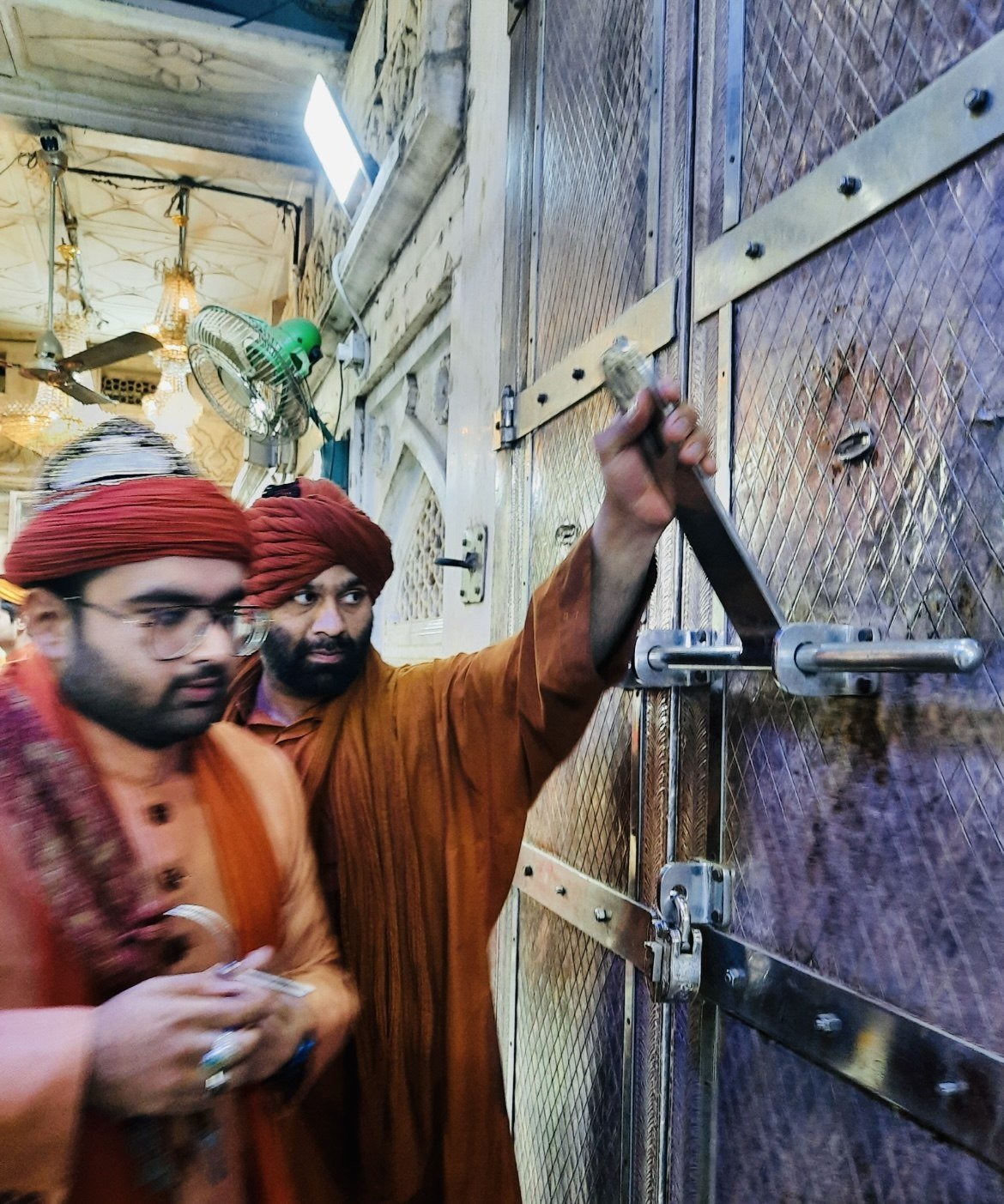
In summer at 4:30 AM and in winter at 5:00 AM, at the break of dawn, the eastern door of the Begami Dalan is unlocked following the morning call to prayer (Azaan). As the second door is opened, salutations (Salat-o-Salam) are recited.
Living Heritage Preserved Across Centuries
Every ritual inside the Asthana-e-Aliya is performed with strict precision according to ancient protocols established since the Mughal era and maintained exclusively by Khuddam Syedzadgan.
Salat-o-Salam (Blessings and Salutations)
Morning Khidmat (Sacred Service)
When the attendants participating in this service enter the Holy Dome, the door of the Begami Dalan is locked from the inside. At this time, only members of the Khuddam family remain inside the Holy Dome; no outside individuals are permitted to enter.
Upon entering the Holy Dome:
1. The floor of the inner courtyard of the sacred tomb is thoroughly swept using a large broom (Farsha).
2. The coverings (Chadar), rose petals, and flowers are removed from the tomb, and residual flowers are cleared using a whisk (Chawar).
3. The sacred velvet cover (Gilaaf) is folded and placed at the foot of the tomb, and the wooden canopy/platform (Takht-e-Mazar) is wiped clean using the whisk.
4. All these floral offerings are gathered in a cloth (Jhab) and sent to the sacred tomb of Hazrat Bibi Hafiza Jamal (R.A.) (daughter of Khwaja Sahib).
5. Neem leaves, a fresh cloth cover, and ties (Bastani) are offered upon the luminous tomb.
6. A fresh bed of flowers (Chadar) is laid over the sacred tomb.
7. The Khuddam then offer prayers for general well-being (Dua-e-Khair / Dua-e-Mustajab).
8. The area between the two silver railings (Nukra'i Kathra) and the outer courtyard floor are swept clean.
9. Finally, the eastern and southern doors of the Holy Dome are opened, and pilgrims enter in crowds for Ziyarat.
2. Sandal Mali (Applying Sandalwood Paste — After Zuhr Prayer)
Regardless of the season, daily at 3:00 PM (and at 2:30 PM on Thursdays), sandalwood paste (Sandal) is applied to the sacred tomb. The service during this time is performed similarly to the morning service. Before offering the cloth cover, flowers, and vows (Nazr), sandalwood paste and perfumed oil (Itr) are applied directly to the surface of the sacred tomb. If the velvet cover (Gilaaf) needs to be changed, it is replaced at this time, and the removed cover is safely stored in the treasury (Tausha-Khana).
3. Tausha-Khana (Treasury Vaults)
There are two rooms located on the western side of the Holy Dome, each known as a Tausha-Khana.
Northern Vault: Located to the north of the eastern door of the Begami Dalan. It houses daily covers (Gilaaf), neem leaves, and silver items. It remains secured under a single lock, the key to which stays with the keyholder (Baridaar) of the day.
Southern Vault: Located to the south of the eastern door of the Begami Dalan. It stores old covers, quilts, and silver heirlooms. The historic Shahjahani Royal Decree (Farman) regarding the endowment of the shrine is also preserved here. This vault is secured with seven locks. Each key is held individually by seven designated representatives (Musharun-Ilaih) of the seven Khuddam clans. The vault cannot be opened unless all seven representatives assemble together.
4. Danka (Drum Beat — Before Maghrib Prayer)
Approximately 20 minutes before Maghrib prayer, three Khuddam members carry indigenous yellow candles from the Hujra-e-Roshni (Room of Light) adjacent to the small cooking cauldron (Deg-e-Khurd).
As they arrive at the central courtyard (Sahan-e-Charag), the official drum-beater (Naqqarchi) strikes the drum (Naqqara Daoodi) with four beats. Attendants refer to this as "Danka Baj Gaya" (The drum has sounded).
As the three Khuddam walk through the courtyard of the Masmudi/Sandali Mosque toward the Begami Dalan door, they recite the following prayer of devotion:
Shower your grace and mercy upon those assembled here.
Your exalted title is 'Ata-e-Rasool' (Gift of the Prophet),
And it is the noble way of the generous
To protect and uphold their humble servants."
5. Roshni (Ceremony of Lights)
The three Khuddam step outside the silver railing in the western portion of the Holy Dome, standing along the western wall. In front of them, four silver lamps (Nukra'i Kandeel) are arranged in a row.
1. One of the three attendants lights the candle inside each lamp.
2. All four attendants raise these four lamps above their heads.
3. Standing near the prayer niche (Mehrab) facing south, one of the Khuddam recites a Persian praise poem (Manqabat).
4. At the end of every fourth verse, the entire congregation resounds with "Aameen".
Persian Manqabat Recited During Roshni:
خواجہ خواجگاں معین الدین
اشرف اولیائے روئے زمین
آفتاب سپہر کون و مکاں
بادشاہ سریر ملکِ یقیں
در جمال و کمالِ او چه سخن
این مبین بود بحصنِ حصیں
مطلع در صفاتِ او گفتم
در عبارت بود چو دُرِّ ثمیں
اے درت قبلہ گاہِ اہل ایقیں
بر درت مہرو ماہ سودا جبیں
روئے بر در گہت ہمیں سایند
صد ہزاراں ملک چو خسروِ چیں
خادمانِ درت ہمہ رضواں
در صفا روضہ ات چو خلدِ بریں
ذرہء خاکِ او عبیر سرشت
قطرہء آبِ او چو ماءِ معین
الہی تا بود خورشید و ماہی
چراغِ چشتیاں را روشنائی
English Translation:
Master of masters, Moinuddin,
The most noble among all saints on the face of the Earth.
Sun in the firmament of both realms and domains,
Sovereign ruler upon the throne of absolute faith.
What praise can express his beauty and perfection?
Manifest like an impregnable fortress.
In describing his attributes, I have composed verses,
Written in language precious as flawless pearls.
O Master! Your threshold is the Qibla for the people of certainty,
Where the sun and the moon bow their foreheads in devotion.
Upon your doorstep, thousands of kings—
Like the Emperor of China—humbly rest their faces.
The servants at your door are like the guardians of Paradise,
And your pure shrine is radiant like the highest Heaven.
Every particle of its dust is infused with fragrant ambergris,
Every drop of its water shines like pure flowing crystal.
O Lord! So long as the sun and the moon endure,
Keep the light of the Chishtis forever shining bright!
(Note: Historical consensus suggests these verses were composed during the middle Mughal period.)
6. Three Farashas (Sweepers of the Sacred Floor)
When the drum beats five times , an official designated employee stands before the Begami Dalan and announces loudly: "Five o'clock, Sir!"
Hearing this, privacy (Takhliya) is enforced inside the Holy Dome. The eastern and southern doors are closed.
All candles outside the silver railing are extinguished, except for the four main lamps inside the dome corners, which remain lit.
Three designated Khuddam remain inside the dome, each holding a specialized broom (Farsha). A fourth person is not permitted inside.
They sweep the floor in a precise traditional sequence—starting near the eastern treasury vault, moving toward the head of the tomb near the Quranic niche, gathering flower petals and dust, and exiting through the eastern door of Begami Dalan.
In shrine terminology, this ritual service is called "Farasha Ho Raha Hai".
7. Kadaka (Closing Ceremony Chants — After Isha Prayer)
When the third attendant exits the Begami Dalan, the drum-beater calls out from the courtyard: "Ghadiali: Six o'clock!", and strikes six beats.
Upon hearing the six strikes:
1. Qawwals performing in the southern courtyard and Begami Dalan immediately stop their regular qawwali.
2. They stand up facing the Holy Dome with bowed heads and recite ancient devotional verses (Kadaka / Manqabat).
3. The pilgrims and attendees stand in deep respect facing the Holy Dome.
4. Reciting these ancient verses is termed "Kadaka Gaana" or "Kadaka Padhna".
Verses of the Kadaka:
ہے تو صحیح معین الحق بدہ سنوارا، چشتی چراغ جگ میں اجارا
ہے تو صحیح معین الحق بدہ سنوارا، چتر-چتر اون برن کیے
باون جتن ہرا جوگی اجے پال باجا، اڑ جلو جب ہی پیر حکم کیو
جب سر کو سنبھال کوسن اتارا، ہے تو صحیح معین الحق بدہ سنوارا
تو تھمب دنیا، دین بھیو، ہندل ولی نورِ ہدا حورِ ہدا ہر دوارا
بھیو راج گھیر لين اجمیر، جب کیو اسلام توڑا کفارا
ہے تو صحیح معین الحق بدہ سنوارا، کفر جن توڑے اسلام کیو
جنے گرو نے شان دربار باجا، اتر، دکشن، پورب، پچھم
پیروں کی سنی مکے آوا جا، دین کو تھمب معین الدین خواجہ
بجانے من ज्ञान, دین کو تھمب معین الدین خواجہ، چتر دلہا بنے خواجہ حسن داں
ایک ہی موجزا داند تمہارا، خواجہ دین کو تھمب معین الدین خواجہ
تم بڑے سلطان حضرت چشتی، بڑے تخت اور ملک تمکو ہی چھاجا
روڑا، مٹھو پر اپنا رحم کیجیے، دل کا درد دور کرو خواجہ خواجہ
دین کو تھمب معین الدین خواجہ
English Translation / Paraphrase:
"You are truly the helper of Truth, ornamenting creation;
The lamp of the Chishtis, illuminating the world!
You triumphed over the fifty-two magic arts of the Yogi Ajaypal;
Flew into action the moment your Spiritual Master gave the command!
Pillar of the world and protector of Faith,
Saint of India, Light of Guidance at every doorway!
You broke the reign of tyranny in Ajmer and brought the illumination of Peace and Faith.
Across North, South, East, and West, your glory resounds;
Even the masters of Makkah acknowledge your exalted spiritual station!
O Moinuddin! You are the steadfast pillar of the Faith!
Show your mercy upon the humble and suffering,
And dispel the deep sorrow from our hearts, O Khwaja!"
(Note: These oral poetry traditions date back to the Akbari or Jahangiri eras. While preserved phonetically by generations of Qawwals, key lines remain distinctly clear in classical Hindi/Urdu).
8. Darwaza Maamool (Securing the Doors)
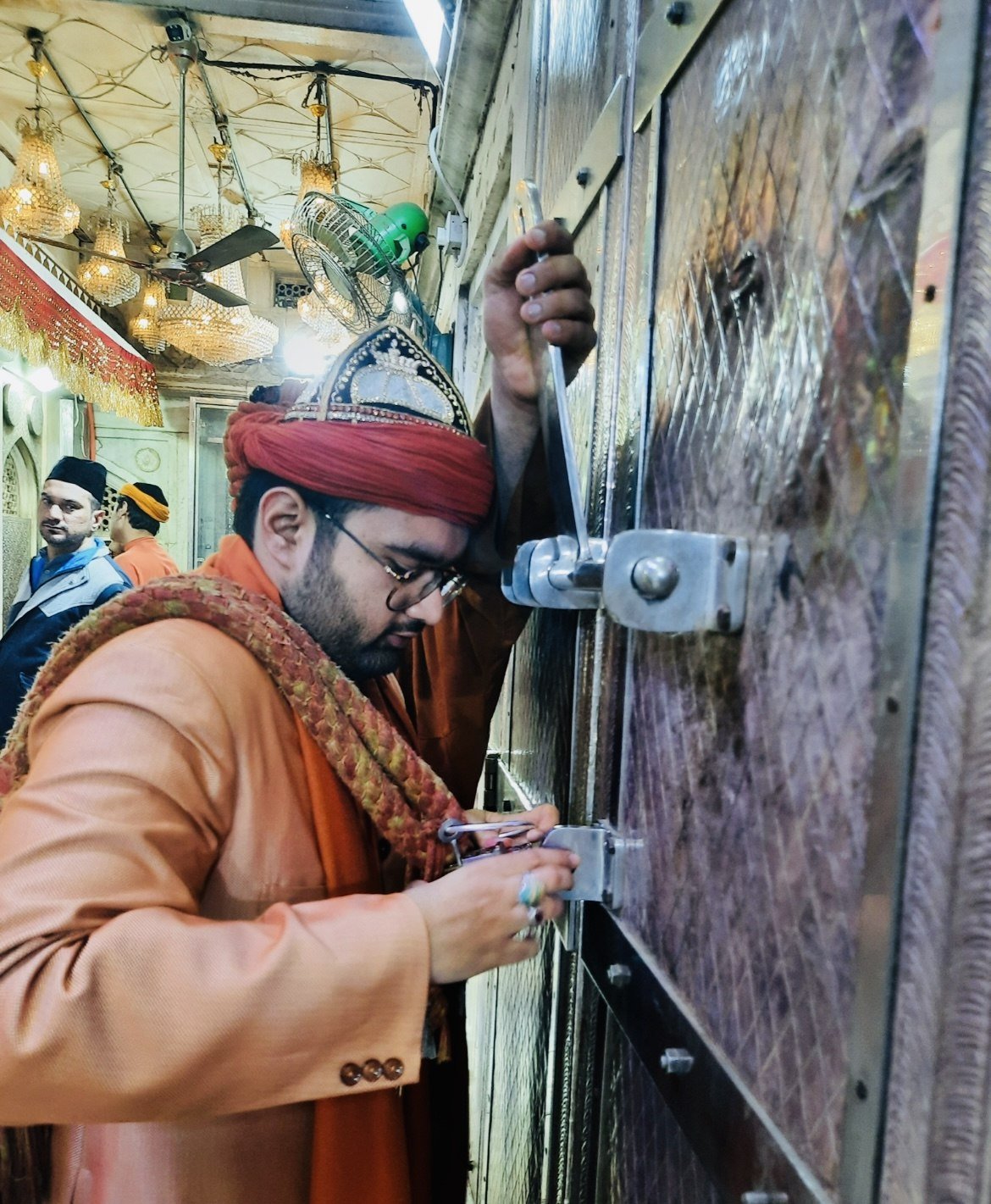
Once the Qawwals complete the Kadaka, the keyholder on duty (Baridaar Khadim) locks the eastern and southern doors of the Holy Dome.
Securing and locking the doors in shrine terminology is known as "Darwaza Maamool Hona". The keys to all doors remain under the direct custody of the day's designated keyholder (Baridaar Khadim-e-Khwaja).