
Hazrat Khwaja Nizamuddin Auliya (R.A.) Mehboob-e-Ilahi – Sultan of Saints
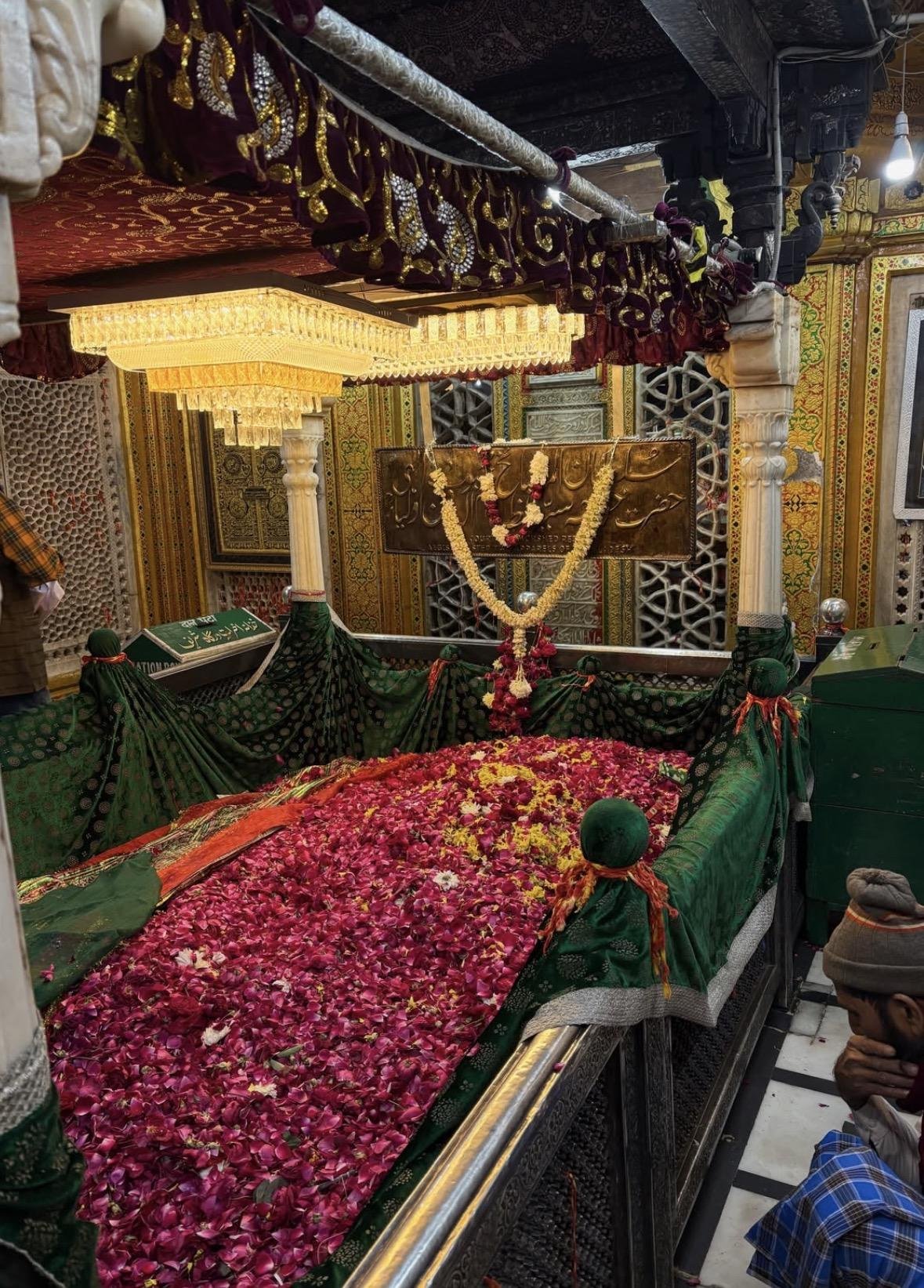
Hazrat Khwaja Nizamuddin Auliya (R.A.)
Delhi, India
“In Allah’s garden, you gather roses, Intoxicated with Divine mysteries. Hazrat Mehboob-e-Ilahi—the Beloved of Allah, How deeply I long for the fragrance of your company.”
- Hazrat Khwaja Nizamuddin Auliya (R.A.)
- Delhi, India
- The Three Essentials of the Dervish
- Ishq — Divine Love
- Aql — Intelligence and Wisdom
- Ilm — Knowledge
- Ishq — The Path of Divine Love
- Hazrat Nizamuddin Auliya (R.A.) became renowned by the title:
- Mehboob-e-Ilahi — The Beloved of Allah
- Aql — Intelligence Transformed into Wisdom
- Ilm — Knowledge
- A Heart Melted by the Remembrance of Allah
- Early Life of Hazrat Nizamuddin Auliya (R.A.)
- Birth
- Education and Scholarly Excellence
- He subsequently studied:
- Arabic grammar
- Ahadith — traditions of the Prophet Muhammad ﷺ
- Tafsir — Qur’anic commentary
- Fiqh — Islamic jurisprudence
- Logic
- Mathematics
- Astronomy
- The Inner Call Towards Spirituality
- He is traditionally reported to have said:
- The First Introduction to Hazrat Baba Farid (R.A.)
- The Qawwali That Changed His Life
- “The living serpent of love has bitten my heart…”
- Journey to Delhi
- “O Pir! Come! I need your protection.”
- In the Company of Hazrat Najibuddin Mutawakkil (R.A.)
- From Scholar to Mehboob-e-Ilahi
- Hazrat Mehboob-e-Ilahi — Hazrat Khwaja Nizamuddin Auliya (R.A.)
Hazrat Khwaja Nizamuddin Auliya (R.A.), who passed away in 1325 A.D., is regarded in the Chishti tradition as one of its greatest spiritual masters and, in many respects, as a figure representing the pinnacle of the Chishtiyya Sufi order in India.
His spiritual master, Hazrat Baba Fariduddin Ganj-e-Shakar (R.A.), is traditionally said to have appointed him as his successor and advised him:
“Be like a great tree, so that Allah’s creation, in its vast multitude, may find rest and solace beneath your shade.”
This teaching beautifully reflects Hazrat Nizamuddin Auliya’s approach to spirituality—open, compassionate and devoted to the welfare of humanity.
His willingness to accept numerous seekers into the Chishti path enabled his disciples to carry its spiritual teachings far beyond Delhi. His representatives travelled to distant regions including Uttar Pradesh, Rajasthan, Gujarat, Bihar, Bengal and the Deccan, where they adapted their work to the needs of the local people while preserving the essential principles of the Chishtiyya tradition.
The Three Essentials of the Dervish
Hazrat Nizamuddin Auliya (R.A.) taught that three qualities are essential for a person travelling upon the Sufi path. He associated all three with the Arabic letter ‘Ain:
Ishq — Divine Love
Aql — Intelligence and Wisdom
Ilm — Knowledge
He explained these qualities as fundamental elements of spiritual development.
Ishq — The Path of Divine Love
At its heart, Sufism is traditionally understood as a path of love. Divine love transforms the lower qualities of the human being and elevates them towards spiritual refinement.
Hazrat Nizamuddin Auliya (R.A.) became renowned by the title:
Mehboob-e-Ilahi — The Beloved of Allah
The title signifies his celebrated spiritual station as one beloved of Allah. In the language of Sufi tradition, the state of being the Beloved is regarded as higher than merely being a lover.
His entire life reflected compassion, love, humility and service to humanity.
Aql — Intelligence Transformed into Wisdom
In the spiritual personality of Hazrat Nizamuddin Auliya (R.A.), intelligence was expressed through wisdom and compassion.
His wisdom manifested itself particularly through his service to humanity. His greatness was not traditionally associated with displays of supernatural power for their own sake. Rather, his spiritual greatness was reflected in the compassion of his heart and his ability to understand the suffering of others.
He is remembered in the source as a saint whose spiritual insight enabled him to perceive the condition of a person’s heart and offer words capable of bringing comfort to those experiencing pain and distress.
His “miracles” were therefore described not merely as extraordinary events, but as the miracles of compassion, understanding and a deeply sympathetic soul.
Ilm — Knowledge
The third essential quality of a Dervish, according to Hazrat Nizamuddin Auliya (R.A.), was Ilm—knowledge.
He was renowned as a scholar of his time. In his youth, he had considered pursuing a scholarly career and even aspired to become a Qazi, but his spiritual longing ultimately led him towards the pursuit of inner knowledge.
After becoming a Mureed of Hazrat Baba Farid (R.A.), he accepted a life of poverty and spiritual discipline.
One of his former friends was surprised to see him living in such circumstances, remembering the promising scholarly career that lay before him. When Hazrat Nizamuddin Auliya (R.A.) related this to his Murshid, Hazrat Baba Farid (R.A.), his spiritual master advised him to recite the following verse to his friend:
“You are not my fellow traveller; Tread your own path. May you be affluent, And I remain downtrodden.”
Hazrat Baba Farid (R.A.) then instructed him to take a tray of food from the kitchen and carry it upon his head to his former friend. After delivering the food, Hazrat Nizamuddin Auliya (R.A.) recited the verse.
The incident deeply moved his friend and demonstrated the humility and spiritual detachment expected of a seeker on the Sufi path.
A Heart Melted by the Remembrance of Allah
On another occasion, someone narrated the story of a saint who passed away while continuously repeating the Name of Allah.
Hazrat Nizamuddin Auliya (R.A.), deeply moved by the story, became emotional and his eyes filled with tears. He then recited:
“I come running to the end of Your street, Tears continually wash my cheeks. Union with You—what else could I seek? I surrender my soul while repeating Your Name.”
These words express the central theme of his spiritual life: longing for Divine closeness and complete surrender to Allah.
Early Life of Hazrat Nizamuddin Auliya (R.A.)
According to the source, the paternal grandfather of Hazrat Nizamuddin Auliya (R.A.), Khwaja Ali, and his maternal grandfather, Khwaja Arab, migrated from Bukhara to India with their families.
They initially settled in Lahore and later moved to Badayun, east of Delhi.
Khwaja Arab’s daughter, Bibi Zulaitaikha, married Khwaja Ali’s son, Khwaja Ahmad. Hazrat Nizamuddin Auliya (R.A.) was born to this family.
Birth
According to the source, Hazrat Nizamuddin Auliya (R.A.) was born on the 27th of Safar, 636 A.H. (1238 A.D.), which fell on the last Wednesday of the month of Safar.
His birth is commemorated in the traditional observances associated with his shrine. According to the source, on the occasion of his birth anniversary, the shrine is ceremonially washed and the water is distributed among visitors.
Education and Scholarly Excellence
Hazrat Nizamuddin Auliya (R.A.) lost his father when he was only five years old.
His mother then devoted herself to his education and sent him to study the Holy Qur’an. According to the source, he mastered the seven recognised modes of Qur’anic recitation at a young age.
He subsequently studied:
Arabic grammar
Ahadith — traditions of the Prophet Muhammad ﷺ
Tafsir — Qur’anic commentary
Fiqh — Islamic jurisprudence
Logic
Mathematics
Astronomy
Among his distinguished teachers was Khwaja Shamsul Malik. He also received a certificate of proficiency in Hadith from Maulana Kamaluddin.
At approximately twelve years of age, he received the “Turban of Excellence”, signifying his scholarly distinction.
He became renowned for his intelligence, understanding and ability in religious debate and acquired distinction in Tafsir, Hadith and Fiqh, along with mathematics and astronomy.
The Inner Call Towards Spirituality
Although Hazrat Nizamuddin Auliya (R.A.) regularly sat in the company of the Ulama, his heart increasingly inclined towards spiritual knowledge and the inner life.
He is traditionally reported to have said:
“In the days of my youth, I used to live in the company of the Ulama, but within my heart there arose a thought that I should leave their company and turn my face towards the Divine Teacher.”
This inner yearning eventually led him towards the Chishti path and towards his destined spiritual master, Hazrat Baba Farid Ganj-e-Shakar (R.A.).
The First Introduction to Hazrat Baba Farid (R.A.)
A turning point came when a Qawwal named Abu Bakr arrived from Multan and visited the teacher of Hazrat Nizamuddin Auliya (R.A.).
The teacher asked him about the great Sufi masters of Multan.
Abu Bakr spoke of Hazrat Sheikh Bahauddin Zakariya Multani (R.A.) and described the intense devotion prevalent in his Khanqah. He then spoke of his journey to Ajodhan, present-day Pakpattan, where he had the honour of meeting Hazrat Baba Fariduddin Ganj-e-Shakar (R.A.).
He described Baba Farid (R.A.) as a great sovereign of Divine Love whose spiritual light illuminated the region.
These words made a profound impression upon Hazrat Nizamuddin Auliya (R.A.). He later recalled that he developed an intense love for Baba Farid (R.A.) and began repeating his name after every Namaz.
The Qawwali That Changed His Life
During the same gathering, the Qawwal began singing a mystical verse beginning with the words:
“The living serpent of love has bitten my heart…”
However, he could not remember the second line.
Hazrat Nizamuddin Auliya (R.A.) helped him complete the verse.
The Qawwal was deeply impressed by the young man’s knowledge and spiritual sensitivity. From that day onward, Hazrat Nizamuddin Auliya (R.A.) became increasingly attached in heart to Hazrat Baba Farid (R.A.).
Journey to Delhi
When Hazrat Nizamuddin Auliya (R.A.) entered his eighteenth year, he travelled from Badayun to Delhi.
He was accompanied by Musamma Ayuz, a devoted admirer of Hazrat Baba Farid (R.A.).
Whenever Ayuz encountered a danger—whether from robbers or wild animals—he would call upon his Pir for protection:
“O Pir! Come! I need your protection.”
Hazrat Nizamuddin asked him about the identity of this Pir.
Ayuz replied that it was the saint who had captured his heart and inspired his love—Hazrat Baba Farid Ganj-e-Shakar (R.A.).
This further strengthened Hazrat Nizamuddin’s faith and attachment to Baba Farid (R.A.).
In the Company of Hazrat Najibuddin Mutawakkil (R.A.)
After arriving in Delhi, Hazrat Nizamuddin Auliya (R.A.) happened to stay near the residence of Hazrat Sheikh Najibuddin Mutawakkil (R.A.), the brother and spiritual successor of Hazrat Baba Farid (R.A.).
His mother and sister were also with him.
The family rented a house in the neighbourhood of this great Sheikh, whose companionship proved extremely valuable to the young Nizamuddin.
In the gatherings of Hazrat Najibuddin Mutawakkil (R.A.), stories and accounts concerning the spiritual greatness of Hazrat Baba Fariduddin Ganj-e-Shakar (R.A.) were frequently related.
Listening to these accounts, Hazrat Nizamuddin Auliya (R.A.) developed such a deep longing that he yearned to travel to Baba Farid and kiss his feet.
He remained in Delhi for approximately three years, during which his longing for spiritual guidance continued to grow.
From Scholar to Mehboob-e-Ilahi
The journey of Hazrat Nizamuddin Auliya (R.A.) illustrates the transformation of Ilm into spiritual wisdom, Aql into compassion, and Ishq into complete devotion.
From a brilliant young scholar in Badayun, he became the beloved disciple of Hazrat Baba Farid (R.A.), and ultimately one of the greatest spiritual personalities of the Chishtiyya tradition.
His life became an enduring example of Divine Love, knowledge, humility, service to humanity and spiritual tolerance.