
Who is Khaddim? The Hereditary Custodians of Ajmer Sharif Dargah
Khuddam-e-Khwaja Gharib Nawaz (R.A.)
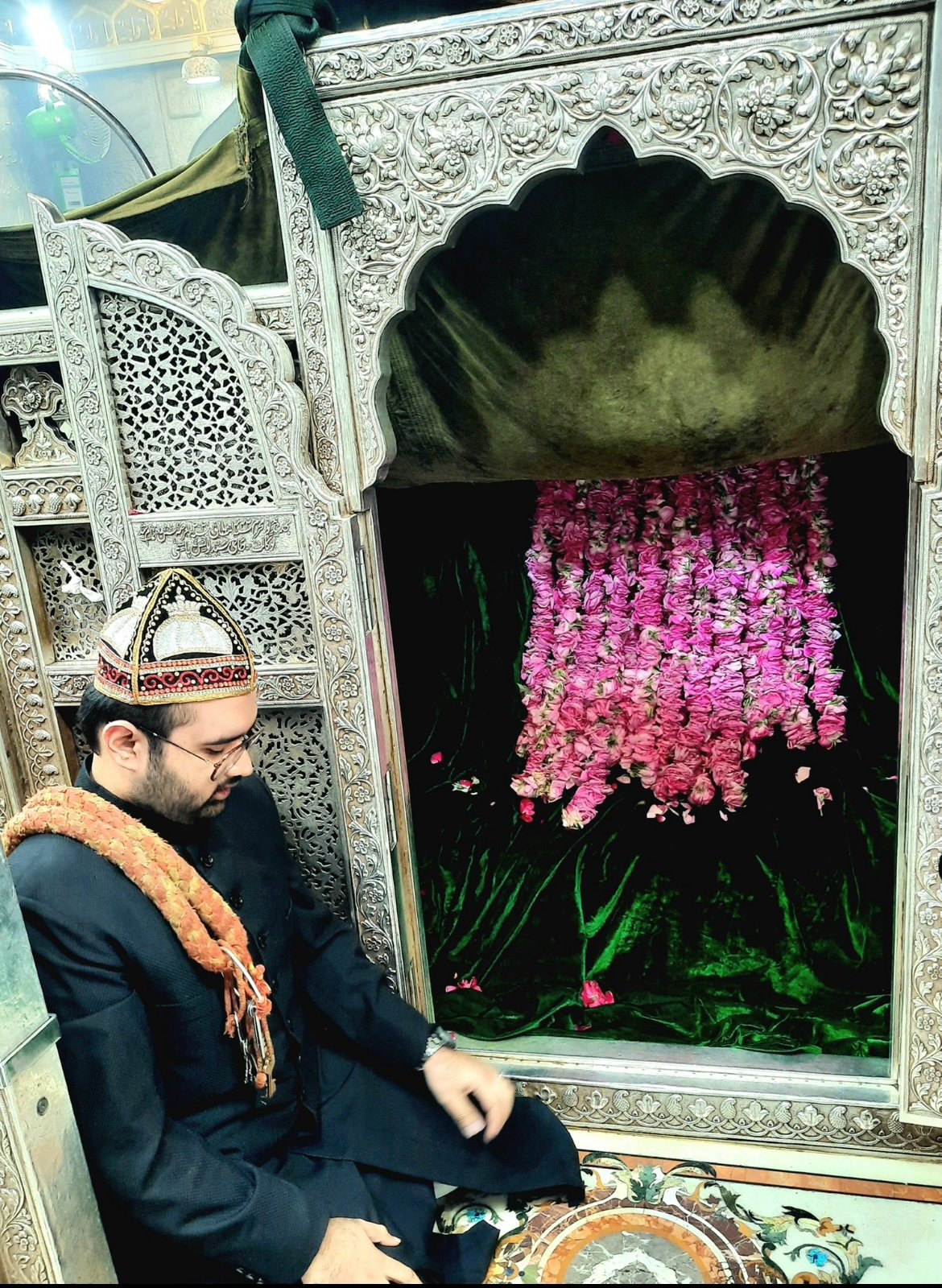
The literal meaning of Khadim is "one who serves". In shrines across the world, custodians are typically salaried employees of endowments (Auqaf); however, the case here is entirely the opposite. Namely, the Khuddam of Khwaja are hereditary custodians who have been performing the duty of serving the sacred threshold of Hazrat Khwaja Gharib Nawaz (R.A.) for the past eight hundred years.
- Khuddam-e-Khwaja Gharib Nawaz (R.A.)
- Har ki khidmat kard oo makhdoom shud
- Sheikh Daniyal
- Emperor Jahangir himself wrote this event in Tuzuk-e-Jahangiri as follows:
- (Tuzuk-e-Jahangiri, Page 16)
- (Tuzuk-e-Jahangiri, Page 16)
- Regarding Sheikh Daniyal, Mulla Nizamuddin Ahmad writes:
- (Tabaqat-e-Akbari, Page 1)
- Abul Fazl writes in Akbarnama regarding Sheikh Daniyal:
- (Akbarnama, Volume II, Page 465)
- Sheikh Daniyal was a pious custodian (Mujavir)."
- Motamad Khan Bakhshi writes:
- (Iqbalnama-e-Jahangiri, Page 244)
- (Jawabnama, Page 144)
- Sheikh Fatahallah
- is further written in this petition:
- The following statement also appears in the same application:
- Rights and Duties of the Khuddam
- Traditions of the Sacred Shrine and the Khuddam
- Keyholding (Kaleedbardari)
- (Tuzuk-e-Jahangiri, Persian to Urdu translation)
- Tirmizi further writes from Tuzuk-e-Jahangiri:
- Tirmizi cites the following historical references:
- Steadfastness of the Khuddam
- The Special Connection and Relationship of the Khuddam
Furthermore, the right of keyholding (Kaleedbardari) of the sacred threshold belongs exclusively to the Khuddam. Just as the keyholding of the Kaaba (Khana-e-Kaaba) has remained entrusted to a specific family since ancient times—and even after the Conquest of Makkah, the Holy Prophet (ﷺ) declared that the key of the Kaaba would remain in their family until the Day of Judgment, and anyone who takes it from them would be an oppressor—similarly, the Khuddam hold this honorable right here.
Even the ruling Monarch of Saudi Arabia takes pride in calling himself the Khadim-ul-Haramain Sharifain (Servant of the Two Holy Sanctuaries).
Sacred Custodianship & Supreme Court Judgments
The hereditary rights of Khuddam Syedzadgan have been historically upheld by Mughal royal firmans, the British Crown, and the Supreme Court of India as intimate, hereditary guardians of the Holy Shrine.
Alhamdulillah! At the court of Khwaja Gharib Nawaz (R.A.), the Khuddam are the keyholders.
The ancestral progenitor of the Khuddam of Khwaja Gharib Nawaz (R.A.) is Khwaja Syed Fakhruddin Gurdezi (R.A.), who was the spiritual brother (Pir Bhai), genealogical cousin/brother (Nasbi Bhai), deputy (Khalifa), and chief attendant (Khadim-e-Khas) of Hazrat Khwaja Gharib Nawaz (R.A.). Regarding his descendants—the Khuddam—observe this verdict of the High Court of Rajasthan (it should be noted that Ajmer is part of Rajasthan state):
"KHADIMS' RELATION WITH THE SHRINE IS NOT ONLY ANCIENT BUT INTIMATE."
People address the Khuddam of Khwaja Gharib Nawaz (R.A.) as Sahebzada, Gaddinsheen, Moallim, Mujavir, and Syed Sahab. The people of Kashmir refer to them as Rishi. However, the Khuddam of Khwaja Gharib Nawaz (R.A.) take immense pride in calling themselves Khadim, Khaknasheen (sitters upon the dust), and Jaroob-Kash (sweepers of the shrine).
Titles & Designations of the Khuddam Family
Devotees from different continents and regions address the hereditary custodians with these historic titles:
Couplet (Persian):
Har ki khidmat kard oo makhdoom shud
The reality is that apart from the day-to-day rituals performed around the clock at the sacred threshold throughout the twelve months of the year, the duty of offering prayers (Dua-goi) has been continuously fulfilled by the Khuddam in their ancient, hereditary capacity. It is for this reason it is said:
"Kuch baat hai ke hasti mit'ti nahi humari,"
"Sadiyon raha hai dushman daur-e-zaman humara."
Thus, every son serves his father, every student serves his teacher, every disciple (Mureed) serves his spiritual guide (Pir), and every devotee serves the master in whom he holds faith and devotion. Therefore, every son is the Khadim of his father, every student of his teacher, every disciple of his Pir, and every devotee of his mentor (Jawabnama, Page 139).
Hence, all disciples in the Sufi path are called the Khuddam of their master, and this terminological title for disciples is documented across all biographical compendiums (Tazkiras) and history books.
Hazrat Khwaja Gharib Nawaz (R.A.) himself is quoted in Siyar-ul-Auliya as follows:
Similarly, some venerable personalities out of deep devotion wrote Mujavir-e-Aastana (Resident Custodian of the Shrine), which the world to this day considers a metaphor. Be that as it may, these are all manifestations of deep love and devotion, for on the path of Sufism (Tariqat):
Persian Couplet:
"Bandagi bayad payambar-zadgi manzoor neest"
That is to say, servitude is necessary in spiritual wayfaring.
The author of Gulzar-e-Abrar, Maulana Ghausi Shattari (written in 1022 AH, Page 38), writes that Hazrat Khwaja Gharib Nawaz (R.A.) repeatedly stated regarding his chief attendant, Hazrat Khwaja Syed Fakhruddin Gurdezi (R.A.):
"Fakhru huma beh Fakhruddin ast"
In Gulzar-e-Abrar, the following words are also present regarding Hazrat Khwaja Syed Fakhruddin Gurdezi (R.A.), the ancestral progenitor of the Khuddam:
"In service, devotion, and piety, he held a supreme station of worship."
Hazrat Khwaja Syed Fakhruddin Gurdezi (R.A.) spent his entire life in the service of Hazrat Khwaja Gharib Nawaz (R.A.). Following the passing of Hazrat Khwaja in Rajab 632 AH (March 1235 CE), he remained seated at the shrine of Khwaja Gharib Nawaz (R.A.) and performed the service of the sacred tomb until his final breath (Gulzar-e-Abrar, Persian text, Page 38).
After him, his descendants turned this service into their life's honor and legacy, a tradition that remains fully established to this day.
Similarly, although Mujavir literally means a neighbor, as everyone familiar with shrine traditions knows, in shrine terminology the custodians of the shrine are called Mujaviran-e-Roza. This is because their outward association with the shrine and their inward spiritual connection (Batini Nisbat) with the occupant of the shrine expresses the true meaning of Mujavirat (custodianship). This honor of service and custodianship has been the treasure and distinction of the Khuddam of Khwaja Gharib Nawaz (R.A.) for hundreds of years.
Mentions of the Khuddam of Khwaja are found in history even before the Mughal era, as evident from the accounts of Sultan Mahmud Khalji (which have been documented in their appropriate context in this book).
However, during the reign of Emperor Akbar, prominent historical evidence regarding the greatness of the Khuddam of Khwaja emerges:
Persian Text:
(Muntakhab-ut-Tawarikh by Mulla Abdul Qadir Badauni, Historian of the Akbari Era, Page 200)
This means Emperor Akbar met with the dervishes and custodians (Mujaviran) of the holy shrine of Khwaja-e-Buzurg. It is further recorded that he took them along with him to the newly constructed Ibadat Khana (House of Worship) and engaged in scholarly and religious discourse with them.
In the community of the Khuddam of Khwaja Gharib Nawaz (R.A.), there were undoubtedly several prominent elders at that time. During research, traces of two specific venerable figures have been found: Sheikh Daniyal and Sheikh Fatahallah (Jawabnama, Page 142).
Sheikh Daniyal
During the reign of Akbar, Sheikh Daniyal was a distinguished elder among the community of the Khuddam of Khwaja Gharib Nawaz (R.A.). In 980 AH, when Emperor Akbar visited Ajmer Sharif and was returning, he left one of his royal consorts at the residence of Sheikh Daniyal because her time of delivery was near. On 12 Jamadi-ul-Ula, a prince was born.
Just as Emperor Akbar named Prince Salim after Sheikh Salim Chishti (R.A.), he named this newborn Prince Daniyal after Sheikh Daniyal.
Emperor Jahangir himself wrote this event in Tuzuk-e-Jahangiri as follows:
(Tuzuk-e-Jahangiri, Page 16)
(Tuzuk-e-Jahangiri, Page 16)
Regarding Sheikh Daniyal, Mulla Nizamuddin Ahmad writes:
"He was distinguished among the spiritual masters of his time in piety and righteousness."
(Tabaqat-e-Akbari, Page 1)
Abul Fazl writes in Akbarnama regarding Sheikh Daniyal:
"The light of righteousness and spiritual success shone upon his forehead."
(Akbarnama, Volume II, Page 465)
Mulla Abdul Qadir Badauni, the authoritative historian of Akbar's era, writes in Muntakhab-ut-Tawarikh:
Sheikh Daniyal was a pious custodian (Mujavir)."
Motamad Khan Bakhshi writes:

"He possessed distinction in outward righteousness and inner purity."
(Iqbalnama-e-Jahangiri, Page 244)
This historic house of Sheikh Daniyal still exists today. Formerly known as Daulatkhana-e-Daniyal, it is now known as the Royal Palace (Shahi Mahal), and to this day, the descendants of Sheikh Daniyal—the Khuddam of Khwaja Gharib Nawaz (R.A.)—continue to reside in it.
(Jawabnama, Page 144)
This decree issued 46 years after the birth of Prince Daniyal proves that "Syed Dan" was the popular alias (Urfiyat) of Sheikh Daniyal, whose descendants resided in the royal palace.
Sheikh Fatahallah
Among the community of Khuddam of Khwaja Gharib Nawaz (R.A.), another distinguished elder was Sheikh Fatahallah. He was remembered with titles of piety and virtuous conduct in an official decree of Akbar dated 29 Safar 984 AH. His son, Syed Hashim, was addressed with reverence as a seat of guidance in Jahangir's royal decree dated 4 Shahriyar 5th Regnal Year (1019 AH).
Regarding Sheikh Fatahallah, his grandson Syed Dan bin Syed Khubullah bin Syed Hashim wrote in a petition:
is further written in this petition:
"Emperor Jahangir would personally request food prepared by my grandfather and dine from it."
The following statement also appears in the same application:
Similarly, other Khuddam members hold royal Mughal land grants (Jaageer) consisting of seven and a half villages granted by Mughal Emperors. The breakdown is as follows:
Beer, Raygarh, Kankaniyawas, Byontja, Banewadi, Modajhadi, Gegal, and half of Nandla. The title deeds (Sanads) for these grants remain in the possession of the descendants of these Khuddam to this day.
Maulana Mani compiled royal Mughal decrees in his book Aasnaad-us-Sanadeed, which was referenced by S.A.I. Tirmizi, Director of the Archaeological Survey of India, in his book Mughal Documents. Tirmizi recorded English translations of Persian Mughal decrees from 1526 CE to 1627 CE, published by Manohar Publications, Ansari Road, Daryaganj, New Delhi.
The state of these elders was such that upon seeing their faces, visitors would recite blessings (Darood). Observing their noble conduct, people recognized their close spiritual affinity with Hazrat Khwaja Gharib Nawaz (R.A.). Inspired by their exemplary character, observers expressed their heartfelt admiration with these words:
Persian Couplet:
"Salah-o-ahliyat pasandida darand-o-ba har kas beh tawazu-o-inkisari pesh mi aayand"
In the hospice centers (Khanqahs) of these elders, carpets of guidance were laid where seekers of truth gathered to receive spiritual education. Offerings (Nuzurat-o-Futuh) were presented to them, yet they accumulated no wealth. Whatever came, they consumed and distributed to others, sleeping peacefully at night after giving away everything. At the time of Tahajjud (late night prayer), they rose to engage in the remembrance of Allah in a quiet corner of the shrine. Such was the enduring tradition of the Chishti spiritual masters (Jawabnama, Page 146).
Rights and Duties of the Khuddam
Rights and duties are inseparable, like two sides of the same coin. As the famous legal maxim by J.A. Symond states:
Accordingly, keeping their rights in view, the Khuddam fulfill their sacred duties with distinction, and Insha'Allah, will continue to do so until the Day of Judgment (Aameen).
Traditions of the Sacred Shrine and the Khuddam
The ancient importance of the Khuddam of Khwaja Gharib Nawaz (R.A.) is intrinsically linked with their duty of keyholding (Kaleedbardari), which forms an inseparable and indivisible part of their rights. In 1949, Sahebzada Maulana Khwaja Abdul Bari Mani (R.A.) authored the response to the official Inquiry Committee questionnaire, throwing scholarly light on the duty of keyholding backed by documentary proofs. It is essential to present it here so readers gain full awareness of the rights of the Khuddam.
Keyholding (Kaleedbardari)
Following the construction of the holy dome, the schedule for opening and closing the shrine (Auqat-e-Basto-Kushaad), the duty of keyholding, and the daily management in summer and winter rested entirely with the Khuddam of Hazrat Khwaja Gharib Nawaz (R.A.). This system was formalized during the reign of Sultan Mahmud Khalji, and family members divided these keyholding duties among themselves. At that time, there was no administrator (Diwan or Mutawalli), nor any government endowment department or managing committee attached to the shrine.
During the reign of Shah Jahan, an official agreement was reached among the Khuddam regarding this division. The original document is available, bearing the title:
"Division of Keyholding Income Shares among the Custodians"
This document was drafted during the 28th regnal year of Shah Jahan, dated 29 Dhul-Hijjah.
Emperor Shah Jahan arrived in Ajmer on 25 Dhul-Hijjah 1064 AH (28 October 1654 CE), and on 15 Muharram 1065 AH, royal offerings were made. On that occasion, Shah Jahan presented ten thousand rupees at the sacred shrine (Shahjahan-Nama, Manuscript, Folio 156).
Following this royal offering, during the Emperor's presence in Ajmer Sharif, the Khuddam settled their internal arrangements through a council system as follows:
In this settlement, there was no interference from the King, local government, or shrine manager (Mutawalli). This document proves that from the era of Mahmud Khalji to the reign of Shah Jahan, the method of dividing keyholding duties remained unchanged. Variations occurred only when shareholders passed away, leading to adjustments in representation and shares. Each day of the week had a designated representative whose turn arrived weekly to perform the blessed duty of keyholding.
When there were no valuable items inside the shrine, no responsibility fell upon these keyholders other than performing the physical service of the sacred tomb.
In Jamadi-ul-Ula 1025 AH (1616 CE), Emperor Jahangir installed a gold railing around the tomb to fulfill a vow (Mannat), as recorded in his own memoirs:
Persian Quote:
The addition of this precious gold railing naturally increased the responsibility of the keyholders, yet the royal government did not interfere in the management of the holy dome. Later, during the early reign of Alamgir, Princess Jahanara Begum (daughter of Shah Jahan) replaced it with the current silver railing.
In the manuscript Riyazul Auliya (authored in 1090 AH by Bakhtawar Khan), it is recorded:
All these precious items were kept inside the treasury vaults (Toshakhanas) of the holy dome. The doors to these vaults are located in the eastern wall of the dome. Inside these exact vaults are the tombs of the ancestral progenitor of the Khuddam, Khwaja Syed Fakhruddin Gurdezi (R.A.), and his noble wife, which were incorporated inside the vaults during the dome's construction.
All items belonging to the shrine remained under the management of the Khuddam according to ancient custom, and the keys to those treasury vaults remained with them. The government instituted no new supervision; whatever was presented was given as an offering (Nazar), and the Khuddam safely preserved these articles for shrine use without third-party interference (Jawabnama).
*"Had these items not been presented as an offering (Nazar), Jahangir would have reclaimed the gold railing. Furthermore, had it been endowed property (Waqf), the administrator of that era would have sold the gold for other uses. However, this did not happen. The railing was presented as a fulfilled vow and was specific to the tomb; hence, it remained under the direct custody of the Khuddam. When the silver railing was installed, the Khuddam transferred the gold from Jahangir's railing into a vault inside the shrine at their discretion.
In 1307 AH (1890 CE), during a civil lawsuit when the District Collector and Magistrate Mr. A.F. D-Luce was acting as Receiver for the shrine, the shrine treasury faced a financial deficit. The shrine urgently required funds, whereupon the Khuddam brought out this gold from Jahangir's railing along with other articles from the vault. The items were liquidated for 75,000 rupees, which was used to construct new water reservoirs (Talaab) and repair old ones across shrine properties."* (Jawabnama, Pages 84–85)
Apart from this gold railing offering, historical accounts demonstrate Emperor Jahangir's deep devotion to Khwaja Gharib Nawaz (R.A.).
S.A.I. Tirmizi translated Mughal decrees from Persian to English. In his translation of Tuzuk-e-Jahangiri, Jahangir's profound devotion is recorded as follows:
(Tuzuk-e-Jahangiri, Persian to Urdu translation)
Tirmizi further writes from Tuzuk-e-Jahangiri:
Tirmizi cites the following historical references:
1. Tuzuk-e-Jahangiri, Vol. 1, (tr.) op. cit., pp. 267–68; 256; 279; 297; 329
2. W. Foster (ed.), Early Travels in India (1583–1619), London, 1927, pp. 171, 280
3. Purchas and his Pilgrimages, op. cit., p. 491
4. Ajmer through Inscriptions, p. 18; M.K. Hussain, Jam-e-Sahat Coin of Jahangir, Journal of the Numismatic Society of India, Vol. XLI, pt. II (Varanasi 1997), pp. 103–15
Steadfastness of the Khuddam
In 1947, during the turmoil of Partition, a large portion of Ajmer's population migrated to Pakistan. Even Diwan Aale Rasul Khan, appointed by the government, migrated to Pakistan. However, the descendants of Hazrat Khwaja Syed Fakhruddin Gurdezi (R.A.)—the Khuddam—remained steadfast with courage, continuing their service at the sacred shrine. This steadfastness is living proof of the spiritual power of Khwaja Gharib Nawaz (R.A.).
The Special Connection and Relationship of the Khuddam
The connection of the Khuddam with the sacred threshold spans nearly eight hundred years. Khwaja Gharib Nawaz (R.A.) demonstrated his affection for his chief attendant, Hazrat Khwaja Syed Fakhruddin Gurdezi (R.A.), by naming his eldest son Fakhruddin after him and entrusting the management of his spiritual hospice (Khanqah) to him.
Following his passing, the Khuddam have carried out the maintenance, upkeep, ritual performance, and preservation of ancient traditions with devotion and excellence. Simultaneously, they foster bonds of unity with millions of devotees regardless of caste or creed, spreading the message and teachings of Khwaja Gharib Nawaz (R.A.) worldwide.
By dispatching these, they are promoting the mission of Khwaja Gharib Nawaz (R.A.). Apart from this, they also make arrangements for the stay, food, and comfort of the pilgrims (zaireen) visiting Ajmer Sharif for pilgrimage (ziyarat) at their own personal expense, and spend large sums of money every year on offerings (nazr-o-niyaz), free community kitchens (langar), and the death anniversaries (Urs) of holy saints. The right to guide these pilgrims through their pilgrimage (ziyarat) belongs exclusively to the Khuddam of Khwaja Gharib Nawaz (R.A.).
During this long span of eight hundred years, Ajmer Sharif faced numerous disasters and upheavals, but the Khuddam of Khwaja Gharib Nawaz (R.A.) were not intimidated in the least. Many a time, people pointed fingers at them out of inner malice, yet the Khuddam of Khwaja Gharib Nawaz remained unaffected, and instead, the detractors themselves failed in their unholy intentions.
With the passage of time, the population of the Khuddam (Khuddam Sahibaan) grew, and to ensure their representation at every level and to safeguard their rights, they established "Anjuman Moinia Fakhria Chishtia Khuddam Khwaja Sahib Syedzadgan" (Registered). The registration years of this Anjuman are 1946 AD and 1947 AD. This organization of the Khuddam fulfills all its related responsibilities and also bears all associated expenses.